There is a common misconception regarding transparency in industrial applications. People often assume that since glass is visually clear, it must let all light pass through. While this holds true for the visible spectrum that the human eye can detect, the rules of physics change dramatically when we move into the ultraviolet range. When it comes to the high-energy wavelengths required for industrial sterilization and curing, standard window glass acts like a solid brick wall.
This physical limitation presents a significant operational bottleneck. Industries and consumers face a major challenge when trying to harness ultraviolet light for water purification, resin polymerization, or air sanitization. Because standard silicate materials block the most critical wavelengths, using them as a barrier renders the underlying technology entirely ineffective. The ultimate solution to this problem is the Quartz UV Lamp. High-purity quartz is engineered specifically at the molecular level to allow maximum radiant energy to pass through without absorption or degradation. In this comprehensive guide, we will dive into the material science, the empirical performance metrics, and the bottom-line financial value of choosing advanced quartz systems over ordinary alternatives.
Recent industry analyses highlight a massive global shift toward chemical-free sterilization protocols. Driven by stricter environmental regulations and a heightened focus on biosecurity, municipal and industrial facility managers are rapidly phasing out legacy chemical treatments. This transition relies heavily on high-output ultraviolet systems. However, as operational capacities scale up, the physical limitations of standard barriers become glaringly obvious. To meet modern compliance standards, upgrading to advanced quartz technology is no longer optional. It has become an absolute industrial necessity.
Key Takeaways
Superior Penetration: A premium quartz bulb allows over 90 percent of germicidal UV-C light to pass through. Standard glass absorbs almost all of these critical wavelengths.
Advanced Material Science: High-purity silica lacks the chemical impurities found in normal glass. This prevents light blockage at the atomic level.
Thermal and Chemical Toughness: Quartz possesses a remarkably low coefficient of thermal expansion. It withstands extreme temperature fluctuations and harsh environments without cracking.
Customizable Options: Depending on the application, quartz can be specifically doped to create a safe indoor environment or left pure to generate ozone for advanced oxidation.
Long-Term ROI: Despite a higher initial manufacturing cost, quartz remains the superior protective housing. It offers significantly longer operational lifespans and better overall energy efficiency.
The Science Behind the Materials: Fused Silica vs. Standard Glass
Understanding why quartz drastically outperforms standard glass requires an objective look at the underlying chemistry. While both materials may appear equally transparent to the naked eye, their atomic lattices interact with electromagnetic radiation in vastly different ways.
At the core of this difference is the chemical composition. Fused Silica, whether synthetically refined or naturally derived, consists almost entirely of pure silicon dioxide. This high-purity amorphous structure features strong, uniform molecular bonds without the interference of chaotic chemical additives. In contrast, standard commercial glass is a complex mixture. To lower manufacturing costs and melting temperatures, glassmakers add various fluxing agents and stabilizers. These include sodium carbonate, calcium oxide, and trace metals like iron. These structural additives fundamentally alter the atomic matrix of the material.
When visible light hits standard glass, the photons do not have enough energy to excite the electrons within the glass molecules. This allows the light to pass through smoothly. Ultraviolet light, however, carries significantly higher energy. When high-energy photons strike standard glass, the impurities—particularly iron oxides—absorb the photon energy. The electrons in these impurities jump to a higher energy state, effectively capturing the light and converting it into a negligible amount of thermal heat. Because pure quartz lacks these energy-absorbing metallic impurities, the photons pass through the molecular matrix unimpeded.
Unmatched UV Transmission: Why Quartz Wins
In industrial sterilization and manufacturing applications, the primary performance metric of any ultraviolet system is its transmission rate. The efficiency of a sanitation setup is directly proportional to the amount of light energy that successfully reaches the target area.
Empirical data consistently demonstrates that high-quality quartz provides exceptional UV Transmission. For germicidal applications, the most critical wavelength is 254 nanometers. This specific wavelength actively disrupts the DNA and RNA of microorganisms. Pure quartz allows over 90 percent of 254-nanometer wavelengths to pass through the lamp wall. High-grade industrial quartz tubes maintain a hydroxyl content below 10 parts per million, ensuring maximum optical clarity. This high transmission rate guarantees that the energy generated by the internal gas discharge is delivered efficiently to the surrounding water, air, or surface.
Conversely, standard glass fails catastrophically in the UVC spectrum. While window glass allows visible light and a portion of UVA ranging from 320 to 400 nanometers to pass, its transmission curve drops precipitously. It reaches near zero percent for wavelengths below 300 nanometers. If a manufacturer were to construct a germicidal lamp using standard glass, the internal arc might generate the correct light, but the envelope would absorb virtually all of it. The resulting output would be useless for disinfection.
Performance Metric
High-Purity Quartz
Standard Silicate Glass
UVC Penetration at 254nm
> 90%
< 10%
Thermal Expansion Coefficient
Extremely Low
High
Operating Lifespan
8,000 - 12,000 hours
Short-lived under UV stress
Solarization Resistance
Excellent
Poor
Durability and Thermal Resistance in Industrial Settings
Beyond optical clarity, components used in commercial environments must endure severe physical stress. Sanitation systems are frequently deployed in harsh settings. From municipal wastewater treatment plants to high-speed manufacturing lines, facility engineers demand materials that offer exceptional physical robustness.
Ultraviolet bulbs generate a significant amount of heat during continuous operation. One of the most critical mechanical properties of fused silica is its exceptionally low coefficient of thermal expansion. Because quartz expands very little when heated, it can handle rapid and extreme thermal shocks. Imagine a high-volume water treatment facility. A hot quartz lamp might suddenly be exposed to a surge of near-freezing water. A standard glass envelope would experience immediate thermal stress, resulting in catastrophic shattering. Quartz maintains its structural integrity through rapid heating and cooling cycles, ensuring safe and continuous operation.
Furthermore, industrial environments often expose equipment to corrosive elements. Quartz exhibits outstanding chemical inertness. It is highly resistant to corrosion from volatile organic compounds, acidic solutions, and harsh industrial cleaning chemicals. This chemical stability ensures that the surface of the lamp does not degrade, cloud, or pit over time. Such degradation would otherwise scatter the light and reduce germicidal efficiency. The longevity provided by this chemical toughness makes quartz an ideal material for heavy-duty operational environments.
Customizing Your Setup: Ozone Free vs. Ozone Generating
One of the most significant advantages of using quartz is its adaptability. Through precise material engineering, manufacturers can customize the spectral output of the lamp to meet strict environmental safety regulations or specific process requirements.
Pure, unmodified quartz naturally transmits the 185-nanometer wavelength. When this specific light interacts with atmospheric oxygen, it breaks the molecular bonds, leading to the formation of ozone. While ozone is a powerful oxidizer, it acts as a respiratory irritant and poses health risks in occupied indoor spaces. To solve this, manufacturers add specific trace elements to the quartz matrix during production, typically utilizing titanium dioxide. This doping process fundamentally alters the transmission curve. It completely blocks the 185-nanometer wavelength while still allowing the safe, germicidal 254-nanometer wavelength to pass. This creates an Ozone Free lamp that can be safely deployed in hospitals, commercial HVAC systems, and residential air purifiers.
There are, however, industrial scenarios where ozone generation is highly desirable. In these cases, pure and undoped quartz is utilized. Ozone-generating lamps are preferred for heavy-duty odor control, commercial kitchen exhaust treatment, and advanced oxidation processes in wastewater management. Because ozone is a gas, it can permeate spaces and crevices that direct line-of-sight light cannot reach. This provides a secondary and highly effective layer of sanitation and deodorization.
Choosing the Right Protective Housing for Your UV System
In liquid purification systems, the electrical bulb is rarely exposed directly to the fluid. Instead, it is housed inside a protective and transparent tube. The selection of this protective housing is just as critical as the bulb itself. When sizing a system, engineers must specify precise dimensions to ensure optimal flow dynamics and protection.
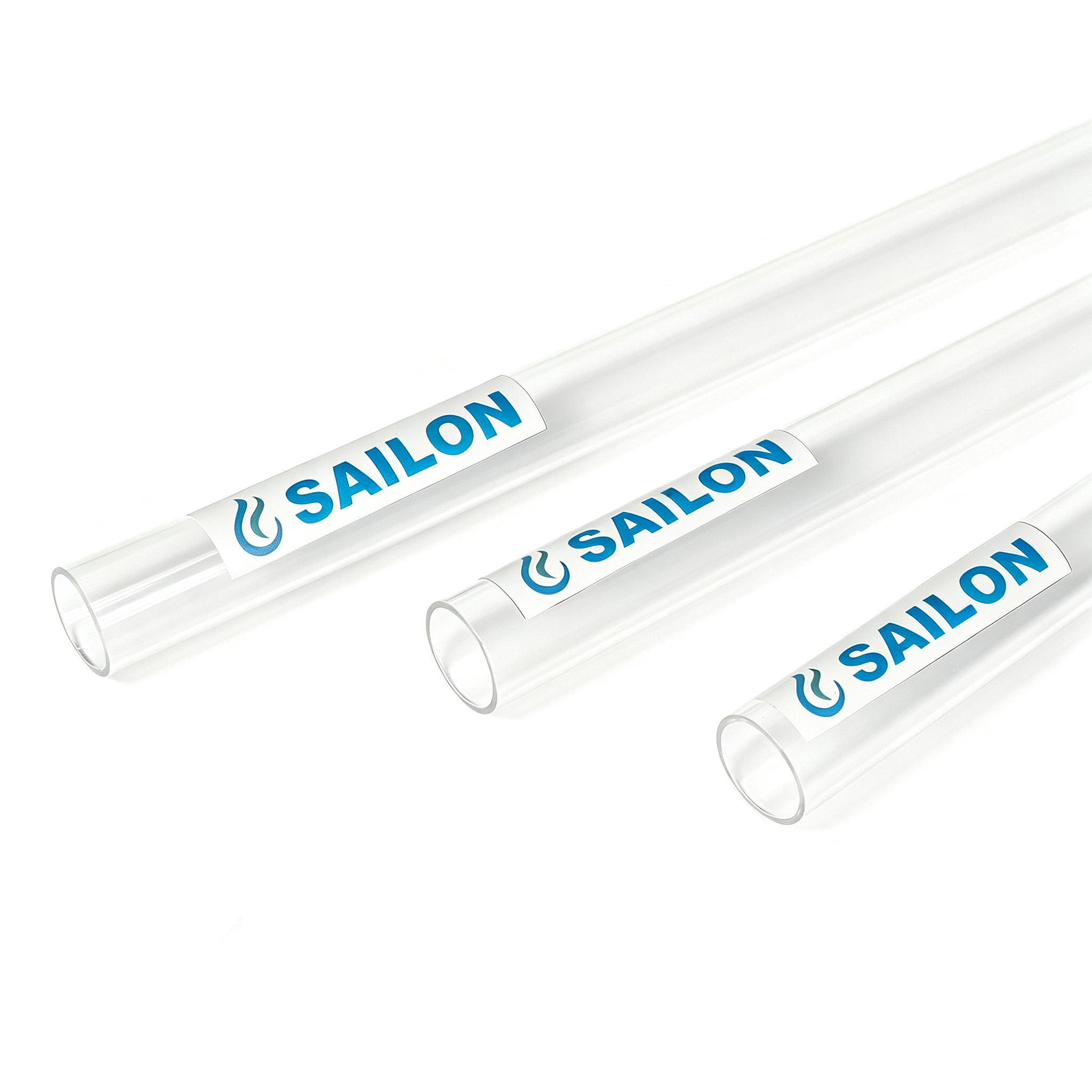
The primary role of the housing is to protect fragile electrical connections from water damage, temperature drops, and physical debris. Simultaneously, it must allow the maximum amount of light to exit the system. Choosing quartz as your Sleeve Material ensures there is no bottleneck in your system's efficiency. Premium quartz tubes can be manufactured with an outer diameter ranging from 10 millimeters to 300 millimeters, and a wall thickness between 1 millimeter and 10 millimeters. They can even be customized in lengths up to 3000 millimeters to fit massive municipal reactors. If a high-output bulb were placed inside a standard plastic or glass sleeve, the barrier would absorb the energy, defeating the purpose of the setup.
To maintain high efficiency, proper maintenance of the sleeve is required. Submerged quartz tubes can accumulate mineral deposits over time, such as calcium and magnesium scale from the surrounding water. This phenomenon is known as biological fouling. It creates an opaque layer that blocks light. Facility operators must implement regular maintenance schedules using mild acidic solutions like citric acid to dissolve mineral buildup. Keeping the quartz clean ensures the system delivers its rated dose consistently over its entire operational lifespan.
Cost vs. Value: Is the Investment Justified?
For procurement managers and facility engineers, the decision to upgrade to quartz systems often comes down to budget constraints. Evaluating this technology requires looking beyond the initial purchase price to understand the true total cost of ownership.
It is an objective fact that manufacturing high-purity fused silica requires extreme temperatures and specialized equipment. This makes it more expensive to produce than standard commercial glass. Yet, the initial capital expenditure should be framed as a long-term investment in operational efficiency. Because quartz offers superior transmission, a significantly higher percentage of the electrical energy consumed by the system is converted into usable light. This high electrical-to-optical efficiency means facilities can achieve the required sterilization dose using fewer lamps or lower wattage. This leads to substantial reductions in ongoing energy consumption.
Furthermore, the total cost of ownership is heavily influenced by maintenance cycles. Standard glass components are prone to a process where the material darkens over time due to radiation exposure, known as solarization. They require frequent replacement due to this and thermal stress. High-quality quartz resists solarization and physical degradation, often boasting operational lifespans of 8,000 to 12,000 hours. The reduced replacement frequency translates to lower consumable costs, decreased labor expenses for maintenance, and minimal system downtime. This makes the investment highly economical over the equipment lifecycle.
Conclusion
When it comes to harnessing the true power of ultraviolet technology, standard glass simply cannot compete with the molecular purity, transmission capabilities, and thermal durability of fused silica. Whether you are outfitting a hospital HVAC system with an ozone-free bulb or upgrading a municipal water plant with heavy-duty protective sleeves, choosing quartz is the only scientifically sound option. By investing in high-quality materials, facilities can ensure maximum pathogen eradication, faster manufacturing speeds, and unparalleled long-term energy efficiency. Evaluate your current sanitation infrastructure today, and consider upgrading your protective housings to maximize your operational success. Visit Sailon UV Lamp at https://www.sailonuvlamp.com to explore our comprehensive range of high-purity quartz solutions tailored for industrial excellence.
Frequently Asked Questions
Does UV light travel through normal glass?
No. While standard window glass lets visible light and a small portion of UVA pass through, it blocks almost 100 percent of UVB and UVC rays. The impurities in the glass absorb the high-energy photons. This is why you cannot get a sunburn through a closed window, and why lamps designed for germicidal purposes must be made of specialized quartz.
What is the difference between fused silica and quartz?
In the context of ultraviolet technology, these terms are often used interchangeably. Fused silica is a synthetic, ultra-pure, non-crystalline form of silicon dioxide. Natural quartz is the crystalline form of the same chemical. Both offer exceptional transmission compared to regular glass, though synthetic fused silica is often preferred for the highest purity applications.
Can quartz glow under UV light?
Pure quartz typically does not fluoresce or glow under ultraviolet light because it lacks the electron structures that cause fluorescence. However, if the material contains trace mineral impurities, it might exhibit a faint glow. High-quality industrial lamps use ultra-pure materials to prevent this energy loss and ensure all radiant energy is directed outward.
How do I know if my UV lamp is ozone free?
An ozone-free lamp is manufactured with specially doped quartz that intentionally blocks the 185-nanometer wavelength responsible for creating ozone from ambient oxygen. You should check the manufacturer specifications or the bulb markings. It will usually be clearly labeled as Ozone-Free or marked with an L for Low Ozone designation.
How often should I clean my quartz sleeve material?
The cleaning schedule depends entirely on the application and the surrounding fluid quality. For liquid purification systems, the protective tube should be inspected and cleaned every 3 to 6 months. This routine maintenance removes mineral scale and fouling, which can severely block light transmission and reduce the system germicidal effectiveness.
How long does a quartz UV lamp last?
High-quality industrial quartz UV lamps typically boast an operational lifespan ranging from 8,000 to 12,000 hours. Unlike standard glass that degrades quickly under UV radiation, quartz maintains its structural integrity and optical clarity over thousands of hours of continuous use, significantly reducing replacement frequency.
Can I replace a glass sleeve with a quartz one?
Yes, upgrading from a standard glass sleeve to a quartz sleeve is highly recommended for any UV system. Ensuring the dimensions match perfectly is critical. By switching to a quartz sleeve, you will immediately notice a dramatic increase in UV transmittance and overall system efficiency, effectively eliminating the optical bottleneck caused by ordinary glass.